Why Mash Conversion Losses Hide in Plain Sight at Grain Distilleries
In a grain distillery, conversion loss rarely announces itself with one dramatic failure. More often, it shows up as a slightly heavy mash, a fermentation that finishes unevenly, a beer still that runs harder than expected, or a yield report that is close enough to normal to avoid immediate investigation.
That is why mash conversion deserves routine attention. The loss can be spread across milling, cook profile, liquefaction, saccharification, viscosity control, and yeast-accessible nutrition. By the time spirit reaches separation, the opportunity has already moved downstream as unfermented carbohydrate, inconsistent alcohol production, higher stillage load, and less predictable cut timing.
Coppercut Catalytics works with beverage alcohol producers that need enzyme programs built for plant-floor realities: grain variability, tight production schedules, existing equipment, and the need for repeatable fermentability without overcomplicating the process.
For teams evaluating a distilling enzyme supplier for spirit production, mash conversion is one of the clearest places to separate commodity inputs from practical process support.
The problem is not always starch. It is access.
When conversion is discussed, the first question is usually whether enough starch has been converted into fermentable sugars. That matters, but it is only part of the picture.
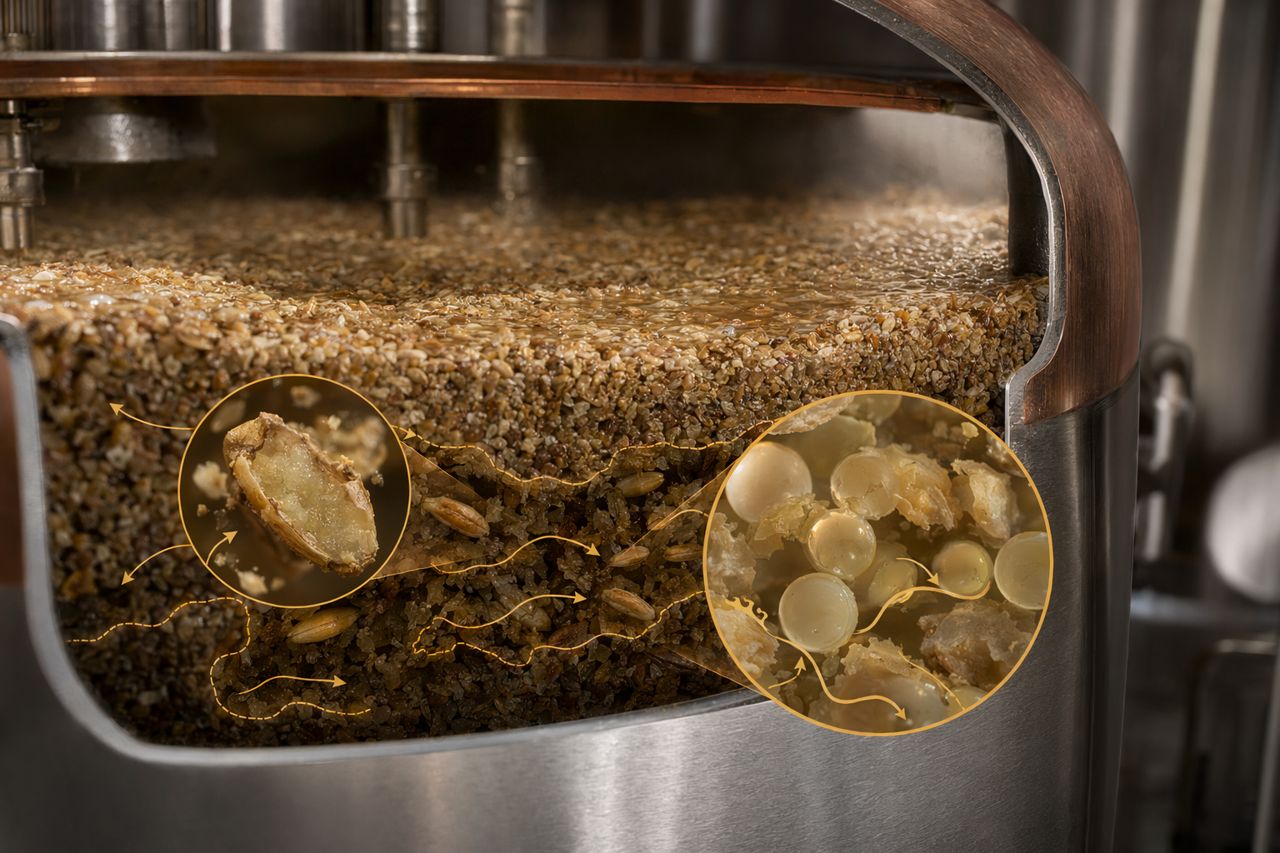
Grain mash is a physical system before it is a biochemical one. The enzyme must reach its substrate. Water must penetrate the grist. Heat must be distributed evenly. Solids must suspend without forming dead zones. Viscosity must stay within a range that allows mixing, pumping, heat transfer, and yeast access.
A mash can appear fully processed while still carrying hidden inefficiencies:
- Partially hydrated particles that do not release starch evenly
- Gelatinized starch trapped inside a viscous grain matrix
- Dextrins left too large or too slowly converted for the fermentation window
- Cell wall materials increasing drag on agitation and transfer
- Protein and grain solids affecting foam, nutrient balance, and downstream separation
- Batch-to-batch differences masked by average production reports
In other words, conversion loss can exist even when the cook looked normal.
Where hidden conversion losses usually start
1. Grain variation enters faster than the process adapts
Moisture, kernel hardness, crop year, storage condition, and grind distribution all affect how a mash behaves. A cook profile that worked last month may not release starch with the same efficiency this month.
If the enzyme program is narrow, the plant may compensate with longer holds, more aggressive heating, slower transfers, or acceptance of lower fermentability. Those adjustments cost time, energy, and consistency.
A more resilient enzyme strategy accounts for raw material variation instead of assuming the grain will behave the same way every run.
2. Liquefaction solves flow, but not always fermentability
Liquefaction is often judged by whether the mash becomes pumpable and manageable. That is a useful operational checkpoint, but it does not automatically confirm that the carbohydrate profile is optimized for fermentation.
If starch is only partially reduced, the mash may move through the system while leaving too much material unavailable to yeast. Production then sees the issue later as slower attenuation, residual extract, or lower-than-expected alcohol yield.
A practical liquefaction program should support both viscosity reduction and the handoff to saccharification.
3. Viscosity quietly steals time and control
High viscosity does not only make mash harder to move. It can reduce heat transfer, slow enzyme contact, limit mixing efficiency, increase pump strain, and create inconsistent conditions within the vessel.
For distilleries pushing throughput, viscosity problems may appear as:
- Longer cook or transfer times
- Uneven tank turnover
- Increased agitation demand
- Variable fermentation starts
- Less predictable still feed behavior
- Higher solids carryover risk
These are not just mechanical inconveniences. They are conversion risks.
4. Saccharification may not match the fermentation objective
Not every spirits facility wants the same sugar profile or process timing. Some producers prioritize rapid fermentability. Others need a controlled conversion profile that fits yeast performance, flavor objectives, equipment limits, and fermentation duration.
A glucoamylase-focused approach can increase fermentable sugar availability, but it must be matched to the mash conditions and production target. The goal is not simply more enzyme. The goal is the right conversion curve for the plant’s fermentation window.
5. Yeast performance gets blamed for upstream limitations
When fermentation underperforms, yeast is often the first suspect. Sometimes that is correct. But many apparent yeast issues begin in the mash.
Yeast cannot efficiently ferment what is not accessible. If carbohydrate release is incomplete, nutrient availability is uneven, or viscosity limits dispersion, fermentation may look sluggish even with healthy yeast management.
Before changing yeast practices, it is worth asking whether the mash is presenting a consistent, fermentable substrate.
What production managers should look for
Hidden conversion losses become easier to manage when the team tracks patterns instead of isolated events. Useful indicators include:
- Fermentation finishing higher than expected
- Alcohol yield drifting below target without an obvious mechanical cause
- Mashes requiring extra time to become workable
- Transfer or pump behavior changing between grain lots
- Increased variability in distillation timing or cut behavior
- Stillage solids or residual extract trending upward
- Repeated need to adjust cook holds to preserve performance
- Inconsistent tank-to-tank attenuation from the same recipe
No single signal proves conversion loss. But when several appear together, the mash deserves a closer look.
Enzyme selection should match the constraint
A good distillery enzyme program is not a generic blend dropped into the process. It should be selected around the actual constraint in the plant.
If the constraint is viscosity
The program may need stronger support for liquefaction and cell wall breakdown so mash moves more predictably through cooking, transfer, fermentation, and still feed.
If the constraint is fermentability
The program should focus on carbohydrate conversion that produces a yeast-accessible sugar profile within the plant’s fermentation window.
If the constraint is raw material variability
The program should provide a wider operating margin, helping the plant absorb grain variation without constant manual correction.
If the constraint is throughput
The program should reduce bottlenecks in mash handling and conversion timing, allowing more consistent tank scheduling.
If the constraint is separation stability
The program should support cleaner, more predictable beer still operation by reducing upstream variability that carries into distillation.
This is where supplier support matters. A technical supplier should help identify the limiting step before recommending a product direction.
A practical enzyme framework for grain distilleries
Coppercut Catalytics typically looks at mash conversion through four practical questions:
1. Is starch being opened efficiently?
This includes milling, hydration, gelatinization, and liquefaction. If starch is not accessible early, later enzyme additions may not fully recover the loss.
2. Is viscosity under control soon enough?
The timing of viscosity reduction matters. A mash that becomes manageable too late may already have lost heat transfer efficiency, mixing uniformity, or process time.
3. Is saccharification aligned with fermentation?
Fermentability should match yeast needs, tank residence time, and production goals. Conversion that is too slow, incomplete, or mismatched to yeast uptake can reduce consistency.
4. Is the system robust across grain lots?
A program that performs only under ideal grain conditions is not enough for a production distillery. The enzyme strategy should help stabilize performance across normal raw material variation.
Why conversion loss is easy to underestimate
Many distilleries are good at keeping production moving. That strength can also hide small process losses. Operators adapt. Tanks get extra time. Transfers slow down. Heat profiles are adjusted. Fermentations are allowed to finish a little longer. Distillation teams work around feed variability.
Those adjustments keep the plant running, but they can normalize inefficiency.
The real cost is often cumulative:
- Lower fermentable extract from the same grain input
- More variability in alcohol production
- Less predictable production scheduling
- Additional energy or handling demand
- Increased load in downstream solids and stillage
- More operator attention spent managing symptoms
Improving mash conversion is not only about yield. It is about making the process easier to run consistently.
How Coppercut Catalytics supports distillery teams
Coppercut Catalytics supplies enzyme solutions for beverage alcohol production with a focus on measurable plant outcomes: fermentability, viscosity control, consistent conversion, dependable run time, and cleaner downstream behavior.
Our approach is direct:
- Understand the grain bill, cook profile, equipment limits, fermentation target, and pain points.
- Identify whether the primary issue is access, viscosity, saccharification, raw material variation, or downstream instability.
- Recommend an enzyme strategy that fits the existing process rather than forcing unnecessary process changes.
- Support production teams with practical evaluation points tied to yield, attenuation, transfer behavior, and separation consistency.
The best enzyme program is the one that helps the plant run steadier without asking operators to chase the mash every batch.
Request a quote for a distillery enzyme program
If mash conversion losses are affecting yield, fermentability, viscosity, or batch consistency, Coppercut Catalytics can help evaluate the right enzyme direction for your grain distillery.
Use the on-site request form to share your grain bill, cook process, fermentation window, and current production goals. We will respond with a practical quote and a technical starting point for your operation.
Request a quote